
Medical Weight Loss
Contrave vs. GLP-1 Injections: Pill or Shot?
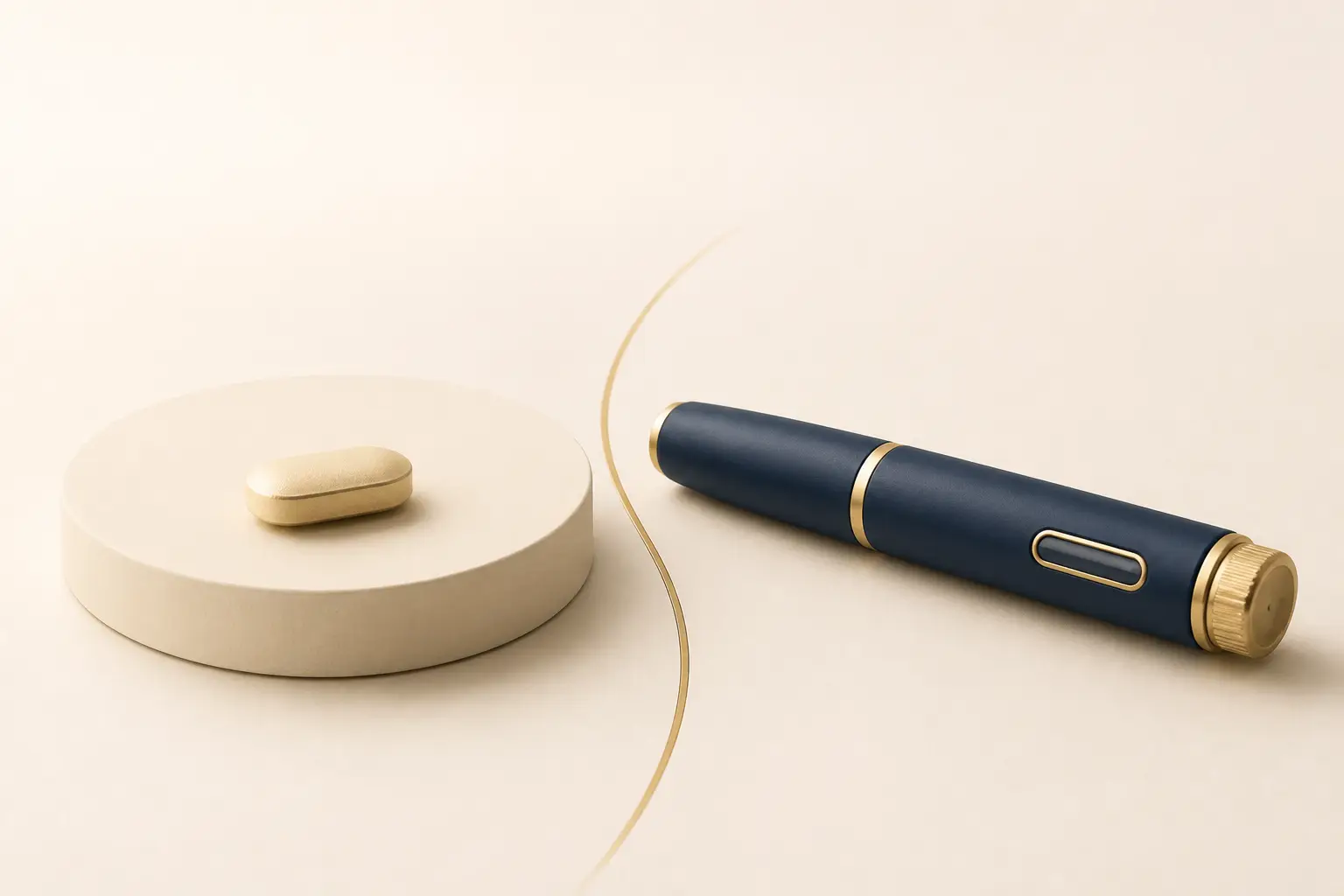
Neither is objectively "better" — they work differently, and the right one depends on you. Contrave is a daily pill that quiets cravings through your brain's reward system, while GLP-1 injections work weekly on the appetite and satiety hormones that control how hungry you feel between meals — and the choice between them usually comes down to needles, budget, and how much weight you're aiming to lose. If you've been staring at both options and aren't sure where to start, here's how our Fort Myers clinic actually walks patients through the decision.
What's the difference between Contrave and GLP-1 injections?
Contrave combines two well-established medications — naltrexone and bupropion — in one extended-release tablet, FDA-approved for long-term weight management. It's non-stimulant and isn't a controlled substance, and you take it every day rather than injecting it weekly. Contrave works on your brain's reward system, easing the grazing and food noise that drive you back to the pantry, rather than working on your stomach's hunger hormones directly.
GLP-1 injections are a different mechanism entirely. Semaglutide and tirzepatide mimic hormones your gut already produces — GLP-1, and in tirzepatide's case, GIP as well — that regulate appetite and how quickly your stomach empties. At our clinic, these are compounded, physician-supervised preparations of semaglutide and tirzepatide; the active ingredients are FDA-approved and well studied, but a compounded preparation is not itself an FDA-approved product, so it's dosed and monitored under direct medical supervision rather than dispensed like a standard retail prescription. You inject once a week, and most patients describe the effect as appetite simply going quiet — less wanting, less thinking about food, smaller portions without a fight.
Both approaches are legitimate medical tools. The difference is where they intervene: Contrave dampens the craving loop, GLP-1 injections dial down hunger signaling itself.
Which one produces more weight loss?
In clinical studies, GLP-1 medications have generally produced larger average weight loss than oral options like Contrave. That's a real pattern worth knowing going in. But an average isn't a promise, and it isn't the whole conversation. Some patients respond powerfully to Contrave and reach their goal without ever touching a needle. Others need the stronger appetite suppression a GLP-1 injection provides to break through a plateau that diet and willpower alone couldn't move. Weight loss isn't a leaderboard — it's what actually works for your biology, your habits, and your timeline.
This is also why "which is stronger" is the wrong first question. The better question is which one you'll actually stick with, tolerate well, and build lasting habits around — because a program you abandon in month two, no matter how strong the medication, produces zero results.
Pill or shot: which fits your life?
This is usually where the decision actually gets made, and it has less to do with the label and more to do with you.
If needles are a genuine barrier — you've put off starting a program for months because you can't picture giving yourself a weekly injection — that alone is a legitimate reason to start with Contrave. A medication you'll actually take consistently beats a stronger one you dread.
Budget matters too. Contrave, as a generic-style oral prescription, is typically the friendlier entry point compared with a compounded, physician-dosed GLP-1 program. Your free consultation helps you compare the available treatment paths, and for patients weighing cost alongside results, Contrave is worth a serious look before assuming an injection is the only path.
On the other hand, if you've already tried oral approaches, if you're managing a larger amount of weight, or if you simply want the strongest available tool from day one, a GLP-1 injection may be the more efficient starting point. A needle-free daily pill is the practical choice for patients who want steady, manageable progress without adding a weekly injection to their routine — but it isn't the only right answer, and it isn't meant to be.
Neither choice is permanent, either. Patients switch directions in both cases — some start on Contrave and move to an injection later if they want more; others start on a GLP-1 program and eventually transition toward maintenance with an oral option. The path adjusts as your goals do.
What do Fort Myers and Southwest Florida patients choose?
We see both paths chosen every week at our clinic on S Tamiami Trail, and there's no single local pattern that wins out. Fort Myers patients weighing Contrave against a GLP-1 injection usually split along the same lines as everyone else — needle comfort, budget, and how much weight loss they're chasing — and neither option is the "default" here.
Seasonal residents on a compressed timeline, arriving from up north for the winter season, often lean toward the stronger average effect of a GLP-1 injection because they're working against a date. Year-round residents building a slower, sustainable habit change more often start with Contrave's gentler daily rhythm. Patients driving in from Cape Coral, Bonita Springs, Fort Myers Beach, and North Fort Myers ask the same practical questions: what does it cost, how bad is the nausea, and how fast can I expect results. There's no wrong door — just the one that fits where you're starting from.
How do you decide which one is right for you?
At a real medical consultation, the decision isn't a coin flip — it comes from a few concrete factors:
- Your health history first. A history of seizures or uncontrolled high blood pressure can rule out Contrave; certain thyroid or pancreatic history changes how we approach a GLP-1 program. Screening happens before any prescription, not after.
- How much weight you're aiming to lose. A modest, steady goal is often well served by Contrave. A larger goal, or a history of plateauing on other approaches, often points toward a GLP-1 injection's stronger average effect.
- Your tolerance for injections and your budget, both of which are entirely legitimate factors in a medical decision, not just practical afterthoughts.
- How your body actually responds, which we track through regular check-ins and adjust in real time rather than locking you into one plan for months.
Your consultation — not a national average, and not a guess — is what decides whether Contrave or a GLP-1 injection fits your body. We supervise the dose changes, the check-ins, and the plan for what comes after you hit your goal, regardless of which path you start on.
Common Questions
Q: Can I switch from Contrave to a GLP-1 injection later? A: Yes. If Contrave isn't moving the scale after a fair trial, or you decide you want a stronger tool, we can transition you to a GLP-1 program and titrate you up carefully. It's a managed adjustment, not starting over.
Q: Is Contrave a good option if I'm afraid of needles? A: Often, yes. Contrave is a daily oral tablet with no injections involved, which makes it a genuinely practical starting point for patients who've avoided weight-loss programs specifically because of needle aversion.
Q: Does Contrave cost less than semaglutide or tirzepatide? A: Generally, Contrave is the more budget-friendly entry point compared with a compounded GLP-1 program, though costs depend on your dose and plan. A free consultation can help you understand which treatment path fits your goals.
Q: Which one works faster? A: GLP-1 injections often show noticeable appetite changes within the first few weeks, and average weight loss tends to be greater over time. Contrave builds more gradually as your dose steps up, with steady results following over the following months. Faster isn't always better if it isn't a fit you'll stick with.
Still deciding between a pill and a shot? That's exactly what your consultation is for — contact us or call (239) 237-2240 and we'll walk through your history, your goals, and your budget to find the plan that actually fits.
Questions about your situation?
Every article on this blog ends the same honest way: the internet can educate you, but it can't examine you. Call (239) 237-2240 and talk to our team in Fort Myers.
Call (239) 237-2240